


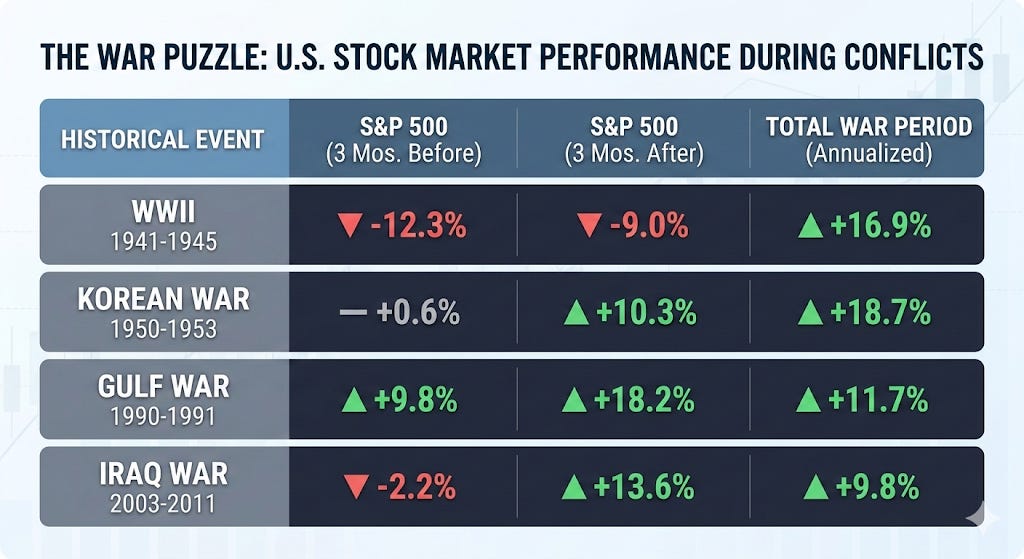
History is filled with tragic conflicts, yet from an investment standpoint, the “War Puzzle” remains one of the most counter-intuitive phenomena in finance. While common sense suggests that military intervention should trigger prolonged market chaos, the data often tells a different story.
In my recent TradeRounds analyses of tactical methods to invest in market cap ETFs and the magnificent 7 technology stocks, we explored how concentration creates internal fragility. Today, we look at how those same concentrated indices react to external shocks—specifically military interventions
The Historical Snapshot
Looking at major U.S. military interventions, we often see a “V-shaped” emotional response from the S&P 500:
Why Does This Happen?
Pre-War Jitters vs. Certainty: Markets hate uncertainty more than they hate bad news. Often, the “dip” happens in the months leading up to the first shot. Once conflict begins, the uncertainty is replaced by a known risk that can be modeled and priced.
The Volatility Paradox: Research (notably by Schwert, 1989) shows that stock volatility is actually 33% lower during wartime. Massive government spending creates stable, predictable revenue streams for a wide swath of the economy, from defense and energy to tech and logistics.
The “Oil Dividend”: While energy spikes cause initial fear, historical data shows that unless oil prices rise by 75-100% and stay there, the broader economy often absorbs the shock within 12 months.
The Takeaway for Tactical Investors:
While the ‘War Puzzle’ shows that markets often defy gravity during conflict, navigating these periods requires more than just historical trivia—it requires a systematic framework. For those interested in the deep math behind these strategies, I invite you to read my two recent peer-reviewed publications on the Social Science Research Network: