


The Systematic Edge
In our original research, we established a rules-based framework for navigating market volatility. This approach identifies the relative momentum across Large, Mid, and Small-cap stocks while keeping a finger on the pulse of the “Canary in the Coal Mine”: TIP (Inflation-Protected Treasuries). Read our full paper on Regime-Aware Market Capitalization Rotation on SSRN and our summary article on TradeRounds.
Most investors suffer from “Index Bias,” staying anchored to the S&P 500 regardless of the underlying regime. Our Regime-Aware Market Capitalization Rotation seeks alpha where it lives while maintaining a hard-coded exit strategy.
The Strategy: The 13612 Momentum Engine
This strategy uses a blended momentum score; the average of 1, 3, 6, and 12-month returns.
The Canary (TIP): If TIP momentum is positive, the regime is “Risk-On.”
The Engine (SPY/MDY/IJR): We rotate into the market-cap ETF with the strongest relative momentum.
The Emergency Brake (BIL): If TIP momentum turns negative, we move to the sidelines in T-Bills (BIL).
Why 2008 to 2026? A Stress-Test of Three Regimes
Readers often ask why our backtest begins in 2008. The start date is dictated by the launch of our “Safety” asset, BIL, which began trading in 2007. Combined with our 12-month momentum lookback, this allows for a clean simulation starting in May 2008.
While this interval is shorter than some historical backtests, it is actually the ultimate “stress test.” It forces the strategy to navigate three distinct and difficult market regimes:
The Deflationary Crisis (2008): As the global financial system buckled, the TIP canary correctly triggered a “Risk-Off” signal. By holding BIL, the strategy avoided the catastrophic 50%+ drawdown seen in equities.
The Quantitative Easing Era (2010–2021): During this decade of Large-Cap dominance, the model effectively rotated between SPY and MDY, capturing the momentum of the “Magnificent” era without losing its defensive posture.
The Inflationary Pivot (2022–Present): Unlike a traditional 60/40 portfolio, where bonds and stocks crashed together in 2022, our Regime-Aware approach utilized BIL and the TIP signal to preserve capital during the fastest rate-hiking cycle in history.
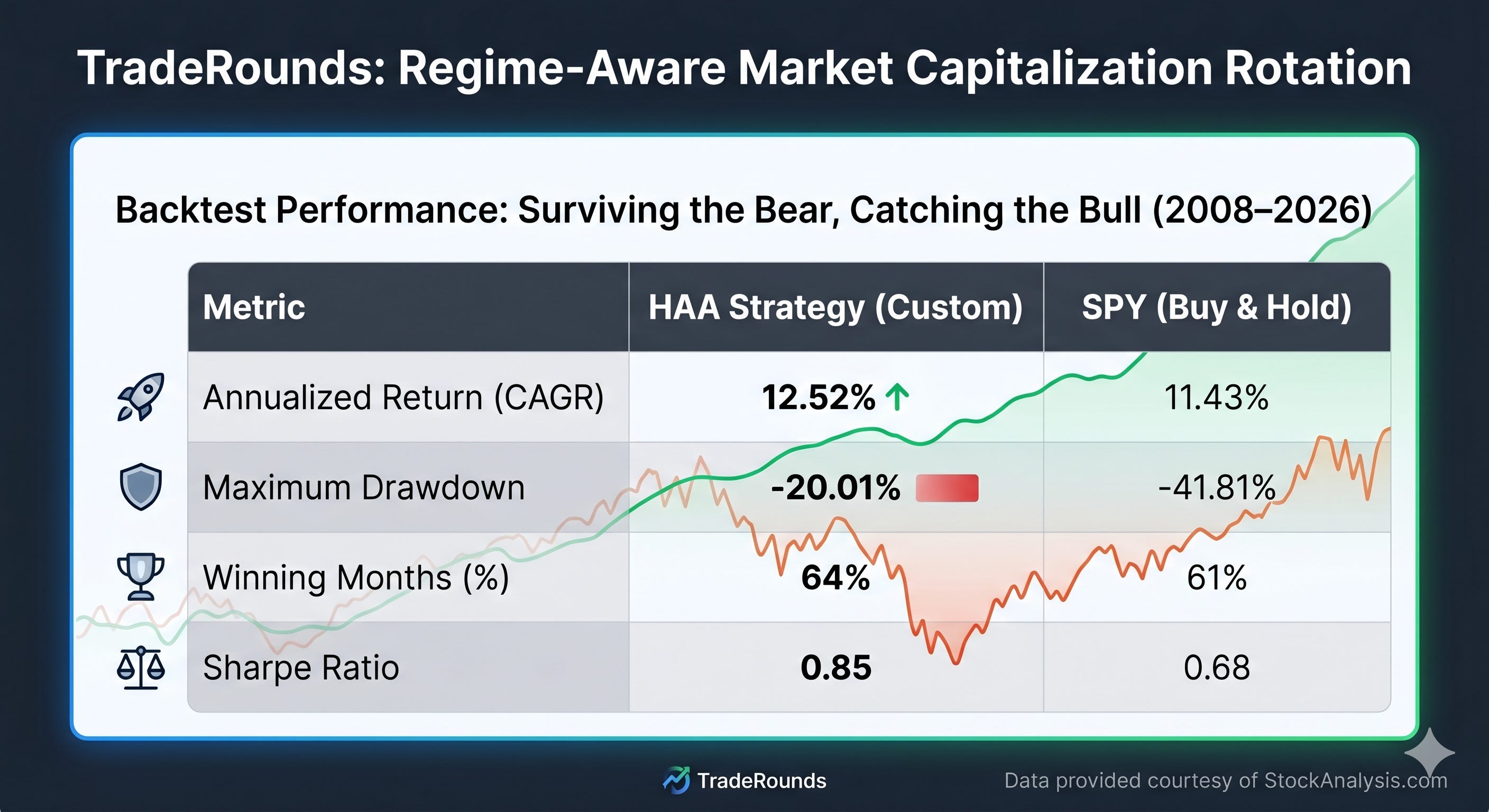
Backtest Performance: Surviving the Bear, Catching the Bull
By successfully navigating these regime changes, the strategy has outperformed a static “Buy and Hold” on a risk-adjusted basis.
By using the TIP canary, we effectively cut the “Greatest Loss” in half. The model sat safely in BIL during the worst of the 2008 Global Financial Crisis and the 2022 inflationary rout, waiting for the signal to return to equities.
Current Signal: The Pivot to Small Caps (IJR)
As of mid-April 2026, the signal has shifted. While 2025 was dominated by Large-Cap (SPY) leadership, our model triggered a rotation into IJR (S&P Small-Cap 600) at the end of March.
Current Momentum Comparison:
IJR (Small Cap): 0.1439 (The Leader)
MDY (Mid Cap): 0.1169
SPY (Large Cap): 0.0998
Despite the headlines focusing on the S&P 500, Large Caps currently have the weakest momentum profile of the three tiers. We are seeing a classic “breadth” expansion where smaller, more sensitive companies are beginning to outpace the behemoths.
Regime Status: RISK ON
The “Canary” (TIP) is still singing with a momentum score of +0.016. While this is a lean signal, it confirms that the current environment remains supportive of equity risk.
Why Not a Standard 60/40?
Many readers have asked how this compares to the traditional 60/40 Stock Bond Portfolio. In a world of volatile interest rates, bonds have often failed to provide the “cushion” they once did. By replacing the bond component with a regime-aware cash trigger (BIL), we avoid the “hidden” drawdowns of fixed income while staying concentrated in the highest-momentum equity tier.
The TradeRounds Playbook
Current Positioning: 100% IJR (Small-Cap 600).
Action: We stay long Small Caps as long as IJR maintains relative leadership and TIP stays above zero.
Next Review: End of April. If TIP momentum turns negative, we exit all equity positions and move to BIL.
How to Follow This Signal
For those looking to implement this “Regime-Aware” rotation:
Monitor the Close: We only rebalance on the last trading day of the month.
Check the Canary: If TIP’s 1,3,6,12 average is negative, go to cash (BIL).
Find the Leader: If TIP is positive, buy whichever has the highest score: SPY, MDY, or IJR.
Stay disciplined. Follow the regime, not the noise.
Disclaimer: This article is for informational purposes only and does not constitute financial advice. Past performance is not indicative of future results.
About the Author: Peter Richman, MD, MBA is a Professor of Emergency Medicine and former Registered Investment Advisor. At TradeRounds, he applies the same evidence-based diagnostics used in medicine to financial markets.